


XGIMI Titan Noir Max : test / review
Published on: 17-04-2026 / Modified: 17-04-2026
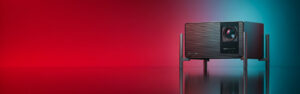
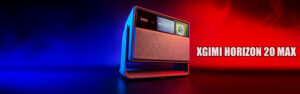
In October 2025, the XGIMI Horizon 20 series saw the light of day and shook up the world of video projection by delivering 3 new triple-laser projectors with lens shift, optical zoom, plenty of brightness and improved contrast. It's not the first time that XGIMI has pushed back the boundaries of what you can get for a reasonable price, but this kind of launch usually happens every 2 or 3 years. So I wasn't expecting another such launch until 2027, but that was without counting on the arrival of the Titan Noir series, which will once again push the boundaries of home video projection.
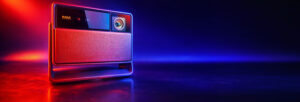
Like the Horizon 20 range, the Titan Noir is available in 3 versions: the basic version, the Pro version and the Max version. Here too, brightness and contrast will play a decisive role in the choice between each projector, and as with the Horizon 20s, I'm going to help you make the right choice objectively. You might be tempted to go for the brightest version, but don't get carried away too quickly - it could be totally counterproductive, and I'll explain why.
Warning
: before diving headlong into the purchase of a Titan Noir Max, be sure to consult the results of this test, as you may be surprised which model to choose.
The Titan Noir range will go on sale on April 23, 2026 via a participatory funding campaign offering a very competitive launch price. I don't have any details on the commercial conditions linked to this campaign, as with Kickstarter the purchase is different from a classic e-commerce site. You'll need to check whether shipping and customs fees are included. You'll also need to check the warranty, which is often limited to 1 year, whereas a purchase on the official site covers you for 2 years in Europe.
If you'd like to take part in the launch campaign, here's the link to the official website:
XGIMI Titan Black / Launch Campaign
Manufacturer web site:
https://www.xgimi.com
Timeline
april 16, 2026: reception of the XGIMI Titan Noir Maxapril 18, 2026: unpacking and first impressions
I'll try to publish the first measurements around April 20-21, and we'll probably have to wait until early May for the rest
Why this projector?
XGIMI has always succeeded in marketing projectors that are accessible to all budgets, always offering good value for money. The main weakness of their projectors compared to some competing models was contrast, but with the Horizon 20 range, they've taken a big leap in the right direction, and they're going the whole hog with the new Titan Noir range. This range uses the word "Black" to emphasize the fact that they have specifically worked on black depth to achieve a better image rendering.The test of the Titan Noir range will therefore be very interesting, as it relies on dual-iris technology and a new DMD chip, so it's not just an update, it's literally a major evolution. We're getting very close to the dream of being able to use a projector in daylight, but I still don't think it's going to be enough to beat a TV in the same conditions. And let's be honest, these projectors aren't within everyone's budget, and it'll probably be a few years before we find projectors of this type in the sub-1000€ budget bracket.
As I've tested the 3 Horizon 20s in depth (and in a quantified, objective way) and I'm going to test the 3 Titan Noir in the same way, you'll have here a unique perspective to make your choice among these 6 projectors.
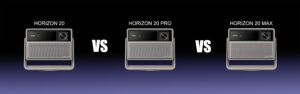
If I mix the two ranges and use brightness to rank them, I get this:
XGIMI Horizon 20: 3200 lumens
XGIMI Horizon 20 Pro: 4100 lumens
XGIMI Titan Black: 4800 lumens
XGIMI Horizon 20 Max: 5700 lumens
XGIMI Titan Black Pro: 6000 lumens
XGIMI Titan Black Max: 7000 lumens
With my Horizon 20 comparison, I had established a threshold at which each projector became interesting in the dark and in daylight.
In the dark:
XGIMI Horizon 20: up to 114 inches
XGIMI Horizon 20 Pro: up to 123 inches
XGIMI Horizon 20 Max: up to 143 inches
This already gives you an idea of the positioning of the new projectors.
Unpacking
Not yet available / testedOperating system
Not yet available / tested
Finish
Not yet available / testedProjection room
My projection room is rectangular, 4.6m by 2.9m (height 2.2m). I have two projection walls, one white wall 2.9m wide with just white paint with a possible 4m setback. I then have a 133 inch ALR screen on another wall with a possible setback of 2.8m. I mainly use the ALR screen except when the layout or type of projector is not suitable for this situation.Battery autonomy
Not yet available / testedPower consumption
Not yet available / testedOperating noise
Not yet available / testedImage quality
Not yet available / testedColorimetry
More explanations on colorimetry
Measuring color fidelity (colorimetry) is not a subjective question, it is something completely measurable. This measurement is carried out with a device (colorimeter, spectrometer, ...) which measures the difference between the real color and the displayed color. This difference is expressed in delta E (abbreviation: dE). A dE greater than 3 indicates a deviation perceptible to the human eye.
The dE must therefore be as low as possible but projectors rarely have a dE lower than 3 out of the box. They are often between 5 and 10, only a calibration can correctly adjust the colors.
For a perfect calibration, you must call a professional. I give you my parameters which correspond to my situation. These settings might work for your situation but it is not a guarantee, so take them as an indication of the direction to follow.
Not yet available / tested
Image Settings
Not yet available / tested
Brightness
More explanations on brightness
The brightness for a projector is absolutely crucial. The brightness is measured in ANSI lumens and the values provided by the manufacturer are very often higher than reality.
I measure the brightness with a lux meter and I convert my measurements into ANSI lumens in relation to the projection surface. You thus obtain a real value.
A video projector, even if it is bright, cannot compete with a television. The contribution of light (natural or artificial) will have the effect of drastically reducing the contrast of your image. With a brightness lower than 1000 ANSI lumens, the projector must be used in total darkness.
Not yet available / tested
Sharpness
Not yet available / tested
Contrast
More explanations on contrast
Contrast (on/off) is used to measure the difference between white and black. This measurement gives an indication of the ability of a projector to produce a good rendering in dark scenes.
A contrast lower than 500:1 should be considered as a very low contrast and the consequence will be especially visible in dark scenes where you will lose details. This is less of a problem for sports, bright films or even cartoons.
A low contrast ratio does not mean that a projector is not usable, you just have to be aware that for films like Aliens, dark scenes will no longer allow you to distinguish details.
Not yet available / tested
Motion compensation
More on Motion Compensation (MEMC)
Many projectors use a frequency of 60 Hz, which means that they broadcast 60 frames per second. Many films were designed to broadcast 24 frames per second. This means that for each second, the film does not have enough frames to fill the 60 frames broadcast by the projector.
This most often results in a jerkiness in the image. Some projectors are able to attenuate this jerkiness with a motion compensation system (also called MEMC). If you abuse this compensation, you will get what is called the 'soap opera' effect which makes the image a little artificial like the TV series of the 80s.
Not yet available / tested
Image size and projection distance
More explanations on the projection distance
The projection distance determines the size of the image and the size of the image is determined by the projector's throw ratio. If a projector has a throw ratio of 1.2, it will have an image width of 83 cm with possibly a gray border.
The distance also plays a role in the brightness because the brightness decreases with the square of the distance. A projector placed at 4 meters will therefore lose 4 times more brightness than a projector placed at 2 meters.
Keystone image correction does not modify the projection cone, it resizes the image inside the projection cone. This means that in the event of a significant correction, you will see a large gray border appear around your image.
Not yet available / tested
Screen choice
Not yet available / tested
Audio quality
More explanations on audio quality
I use several types of music tracks to illustrate the sound quality of the projector but the rendering will always be limited by the recording device. Since I always use the same device, you will be able to compare the difference on the same basis.
I regularly use well-known songs protected by copyright to illustrate the sound quality of a video projector. It therefore sometimes happens that YouTube decides to block my videos for these reasons. In this case, you can listen to the soundtracks directly on YouTube and hope that YouTube has not completely blocked my channel.
Not yet available / tested
Video games
More explanations video games
To be able to play in good conditions with a projector, the latency must be low. Latency is the reaction time between pressing a button on your controller and the reaction on the screen, this latency is expressed in milliseconds and is also called 'input lag'.
I measure this latency with a specialized device. To be able to play fast-paced FPS-type games online, you need to obtain a latency of less than 30 ms. For games where the reaction time is less important, a latency of less than 100ms should be suitable for most situations.
I generally test ShadowRunner from Geforce Now on my Nvidia Shield except when this is not possible. I'm not used to playing with a controller, so I'm not very good at it, but the point is to show the projector's ability, not mine.
Not yet available / tested
Encoutered bugs
Not yet available / testedALR/CLR Projection screen
Are you looking for a good ALR/CLR screen for your projector? I may have what you need:ALR/CLR NothingProjector Screen
Test / Review conclusion
Not yet available / testedStrengths
Not yet available / tested
Weaknesses
Not yet available / tested
 LAURENT WILLEN
Head of myself on this blog
I share my passions on my blog in my free time since 2006, I prefer that to watching nonsense on TV or on social networks. I work alone, I am undoubtedly one of the last survivors of the world of blogs and personal sites.
My speciality? Digital in all its forms. I have spent the last 25 years working for multinationals where I managed digital teams and generated revenues of over €500 million per year. I have expertise in telecoms, media, aviation, travel and tourism.








Questions/Comments