


Bikes
Lankeleisi Kett 8 / electric bike: review / opinion
Published on: 25-03-2026 / Modified: 25-03-2026
It had been a few weeks since I'd started talking to Lankeleisi about testing their new Lankeleisi KETT 8. I'd have liked to test the bike sooner, but the weather wasn't good enough to do a bike test in good conditions. Cold is more or less manageable, but snow, heavy rain and wind are not. So I'm a little behind schedule, but I'm hoping that the weather will now hold out so I can put the miles in on this new bike.
The Lankeleisi KETT 8 is a 250-watt electric bike on the borderline between a city bike and a mountain bike. It's a bit of both, without really getting a foothold in either world, so it's an interesting mix. On paper, it has a lot going for it. I'm thinking in particular of a monster theoretical range of 150 km, central suspension, 85 Nm of torque and all that, without having to take out additional insurance. This bike is approved for use in Europe.
In this test, I'll be using my usual protocol:
- braking test
- acceleration test
- effort test (with heart rate measurement)
- range over several types of terrain
- suspension comfort
and, of course, anything else I can think of.
100€ discount
I have a promo code to get a 100€ discount (price: 2199€ -> 2099€) for this bike on the official website.
To activate the code:
Lankeleisi KETT 8 / activate promo
You'll be redirected to the home page, but the code will appear in your basket as shown in the image below:

To take advantage of this offer, add the bike to your basket:
Lankeleisi KETT 8 / official web site
Manufacturer web site:
https://www.lankeleisi-bikes.com
Timeline
End of February 2026: bike deliveredmarch 7, 2026: first outing, the test can begin.
Unpacking
The Lankeleisi KETT 8 is, as usual, very well packaged. The box is the same size as the others, and the bike weighs around 35 kg. Assembly isn't particularly difficult, and I think it takes just as long to detach all the parts as it does to put them together. The difference with previous models is that here you have to fit the grips and brakes. It's an extra step, but the advantage is that you can adjust the position of the brakes as you like.
It was very windy on the day of assembly, so I lost quite a bit of time catching everything that flew off, but it took me just over an hour to assemble the bike without assistance.
Specifications
| Characteristic | Value |
|---|---|
| Type | Urban electric bike / SUV |
| Motor | 250 W rear hub motor |
| Torque | 85 Nm |
| Maximum power | ≈ 1130 W (peak) |
| Maximum speed | 25 km/h (EU standard) |
| Battery | Samsung 48 V - 20 Ah |
| Battery capacity | 960 Wh |
| Operating range | 55 to 150 km |
| Charging time | 6 to 7 hours |
| Suspension | 120 mm front fork + 105 mm rear suspension |
| Wheel size | 26 × 3.0 inches |
| Sensor | Torque sensor |
| Rider size | 160 - 195 cm |
| Maximum load | ≈ 180 kg |
Overview
The Lankeleisi KETT 8 is positioned as a city bike. With tires of this type, you can still consider country roads, and the suspension will allow you to take a few bumps, so it would be a shame to limit this bike to urban use. The bike isn't very light and portable either, so it's probably less practical if you live in an apartment.Frame
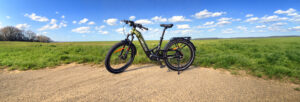
The Lankeleisi's aluminum frame weighs just over 35 kg. Its V-shape is fairly classic, but the special feature is its central suspension. The frame is built differently to accommodate this suspension, giving the impression that the bike bends when you ride it.
Handlebar
The handlebars are nothing special, and the control console is the same as on the other models I've tested. However, I find it a pity that the + and - buttons aren't more accessible, because the first buttons are those for turning on the bike and the horn, whereas changing the assistance level is used more often. I found myself pressing the horn several times when I thought I was reducing the assistance level.
The gearshift on the right works very well, there are 8 gears that you can change quickly and smoothly. I just had a little problem with the chain jumping a bit, but by tightening the derailleur I had no more problems.
Engine
The motor is rated at 250 watts, peaking at 1130 watts for punctual assistance, which should enable you to reduce effort when you suddenly need it. This motor delivers 85 Nm of torque, which is a lot for a bike of this type. As you'll see later in the test, this torque makes the bike extremely responsive. You'll never feel like you're riding a 250-watt bike.
This bike has two types of sensor: the first is a torque sensor that adapts to pedaling force, offering an experience closer to that of a normal bike. There's also a pedaling sensor that will provide maximum assistance at all times, regardless of the pressure you exert on the pedals. The choice between the two is configurable. The bike's responsiveness is really good, and I didn't feel any latency like on some other models.
Crankset/Cassette
The derailleur is a Shimano Altus, as on most electric bikes. The configuration is a little different, however, and will play a big part in your experience with the bike. It's fitted with a single 48-tooth chainring, so far so classic, but the cassette has 8 speeds ranging from 11 to 36 teeth (11-13-16-20-24-28-32-36). I didn't know the bike had 11 teeth when I first tested it, but that explains why I found it so hard to pedal without assistance. This bike is heavy and with a 48x11 configuration, pedaling develops around 9 meters per pedal stroke. I think this is the biggest development I've tested on an electric bike so far.
So, is it good or bad? I'd say it's very good, but you have to be aware of what's involved. With the usual 48x14 configurations, I can ride almost all the time in the hardest gear. Here, that's much less the case, because the effort required is greater. I think this is good because it means you don't have to pedal too fast downhill, but it will probably force you to use a lower gear on the flat. When I ride my bike, I'm almost always pushing it to the limit, and with electric bikes this often means pedaling into the void. With this one, it's very different.
Wheels
Wheel-wise, the bike is fitted with 26" x 3" wheels. So they're not the big tires of a fat bike, but the difference isn't huge. You'll be able to ride this bike just about anywhere, provided the terrain isn't too muddy. Kenda tires have a good grip in most cases, but on very muddy ground, their texture is not deep enough to ensure a good grip.
Suspensions
Suspension at the front is pretty similar to what I've tested on other bikes, with a generous 12 cm of travel. The suspension is also adjustable.
The central suspension is undoubtedly one of this bike's strong points. I'd already tested this type of suspension with the Lankeleisi RV800 Plus and found it particularly comfortable. This one works on the same principle, but I find it even more comfortable. I didn't have to change the pressure, and the suspension handled my 100 kg perfectly. It's a bit of an unusual sensation to have a bike that lowers on the central axis rather than at the rear, but I find it more effective for comfort.
Brakes
The brakes are from Zoom, and as is often the case on electric bikes, the rear brake is on the left, so the forward brake is on the right. These are hydraulic disc brakes, so they're more efficient than conventional disc brakes.
Saddle
The saddle is wide and comfortable, and also height-adjustable, but as you can see from the photo, I had to take it out way beyond the gradation available. I'm 1.94 m tall and would have liked to be able to take the saddle out of the tube a little more, but here I'm already almost at the tube's limit. If you're even taller, you'll probably need a saddle with a longer tube. For my size, it's a bit tight if you like to push hard to get your legs stretched out. If you ride relaxed, it shouldn't be too much of a problem.
Battery
The battery is a Samsung 20Ah 48V battery. If you drive continuously at 25km/h and use the 250 watts of the motor, the battery should last about 3h50, i.e. almost 100 kms. Of course, this is a theoretical measurement that doesn't take into account any external factors or the battery's behavior according to its filling level. However, it can give an idea that will probably put this bike's range above 100kms.
I think my test conditions are fairly normal. Now, if you want to use the assistance to the maximum all the time, and with a significant difference in altitude, the range will surely be halved. If you take it out of gear, it'll be even worse, as you'll lose the benefit of the optimized 250-watt motor.
Screen/Control
The screens are all the same, so there are no surprises when it comes to the information displayed, and the lighting is good enough to make everything readable in bright sunlight. The only fault I can find is that the battery indicator is not quantified, so you never know exactly how much battery you have left. On the other hand, I did notice something specific to this bike in terms of speed. Usually, the speed displayed on the screen is overestimated, and you have to adjust the wheel size in the parameters. With this bike, it's the opposite: I measure a higher speed on my gps. When the display shows 25 km/h, the GPS is close to 26 km/h.
Accessories
The bike comes standard with front and rear lights. The equipment is therefore very complete.
The bike is fitted with a kickstand, and this time it's correctly positioned. On the previous model, the angle of the stand was too narrow, putting the bike in a position where it could fall.
This bike is very well equipped with front and rear lights, indicators, metal mudguards and a luggage rack. I'm very pleased to see that Lankeleisi has dropped the plastic mudguards because they were very noisy and always ended up coming loose.
The bike is equipped with lights on both sides, and you can activate the indicators from the console on the handlebars. That's a big plus for your safety.
The pedals are nothing special, except that they seem lower than usual. With my big feet, I can touch the ground with my heels. It's probably handy for added braking, but I don't think that's the point.
Road test
For my road test, I use several routes and this time I'm going to use my 32-kilometer route to measure my performance on this bike against the other bikes I've tested.Lankeleisi Kett 8:
Course time: 1:13:41
Max pulse: 162
Average pulse: 145
Average speed: 25.9 km/h
Max speed: 47.8 km/h
Lankeleisi RX600 Pro
Running time: 1:13:32
Max pulse: 170
Average pulse: 153
Average speed: 26.1 km/h
Max speed: 49.6 km/h
Racing bike
Course time: 1:18:11
Max pulse: 172
Average pulse: 153
Average speed: 24.6 km/h
Max speed: 49.1 km/h
Duotts C29
Running time: 1:15:30
Max pulse: 166
Average pulse: 146
Average speed: 25.2 km/h
Max speed: 44.5 km/h
My time was very similar to what I'd achieved with the Lankeleisi RX600 Pro (also a 250-watt motor). It was my first outing on a bike after the winter, but my performance wasn't too bad. I think I can probably do even better with this bike, thanks in particular to the crankset/cassette configuration, which should enable me to push much harder on the flat and downhill.
After this varied 32 km ride, my wrists felt a little tired because my height puts me in a position where my wrists are under pressure and the grips don't absorb much shock. It's not the first time I've had this problem, as I rarely get the chance to test bikes that are well adapted to my size. On the other hand, there's no problem with the back, as the suspension does its job very well.
The bike is also much quieter thanks to its metal mudguards, which don't rattle at the slightest vibration. The motor is very discreet, and the thing that makes the most noise in the end is the rear stand, which jumps every time there's a bump.
Brake test
To test braking, I climb to 25 km/h, stabilize and then brake hard, first with the front brake, then the rear and finally both brakes. I can't really measure braking distance (apart from the tire track in this photo), but the braking time speaks for itself.
25 km/h > 0 / front brake: 4 seconds
25 km/h > 0 / rear brake: 3 seconds (with a nice tire track on the ground)
25 km/h > 0 / 2 brakes: 2 seconds
This result is interesting because the gap between the front and rear brake is usually greater, which means that here the front brake is more effective than usual. Braking with the 2 brakes is ultra-efficient, taking barely two seconds to bring the bike to a standstill (with a little rubber burned in).
Acceleration test
To understand how the different assistance levels work, I do a standing start with each level of assistance and measure how long it takes me to reach 25 kph. It's not a scientific method worthy of a laboratory, but it's effective enough to understand how the assistance works.
Here are my results:
Assistance 0 / 0>25 Km/h : 28 seconds
Assistance 1 / 0>25 Km/h : 13 seconds
Assistance 2 / 0>25 Km/h : 8 seconds
Assistance 3 / 0>25 Km/h : 7 seconds
Assist 4 / 0>25 Km/h : 6 seconds
Assist 5 / 0>25 Km/h : 5 seconds
These results speak for themselves, especially if I compare them with the previous 250-watt bike I tested. The times I obtained with this bike are significantly lower than with the Lankeleisi RX600 Pro, which has the same type of motor. The reason is quite simple. It's the crankset configuration that makes all the difference: 48x11 development is bigger and therefore more difficult. This explains why it took me 28 seconds to reach 25 km/h without assistance. Without knowing the crankset configuration when I did this part of the test, I immediately understood that the configuration was different because pedaling was much more difficult.
Here are the results with assistance on the RX600 Pro:
1: 9 seconds
2: 9 seconds
3: 8 seconds
4: 7 seconds
5: 7 seconds
From level 2 onwards, the Kett 8 outperforms the RX600 Pro, and this is where the engine's responsiveness comes into play. The Kett 8 is always ready to pounce and reacts faster than the RX600 Pro.
What does that mean for you?
- If you like to push hard and make an impact on your fitness, the first 2 assistance levels will let you push hard and work your legs
- If you don't want to tire yourself out, assistance levels 3 to 5 offer you a very comfortable ride, with excellent responsiveness and highly efficient assistance
The bikes I've tested so far have been particularly good in the second category (assistance), but I soon found myself pedaling in a vacuum. This is no longer the case, as the resistance of the 48x11 is much greater.
Speed/acceleration test
This bike's assistance is limited to 25 km/h, but that doesn't mean you can't go faster. It's important to understand, however, that with a crankset/cassette combination like the one on this bike, pedaling above the assistance level will require more effort. I've been to several places with a nice descent where I've been able to realize how fast I can go with pedaling without unbridling. On my 2.5% descent, I achieved a speed of around 35 km/h against the wind, which is less than I'm used to. On another 4.5% descent, 480 meters long, I reached 47 km/h. That's less than I'm used to. That's less than I've been able to do with other bikes, but the difference isn't huge either, and I doubt I need to go at such speeds.
In any case, I feel much safer on this bike than on a racing bike at the same speed. Braking is more efficient and the bike is much more stable.
Climb test
For my ascent test, I use the same ascent as for my other tests over a distance of 690 metres and a climb of 2.5%. I ride this climb with all assistance levels and the most difficult speed, measuring my time and heart rate.
Here are the results for this bike:
Assistance 0: 1:58, average speed: 21.5 km/h, 170 heartbeats
Assist 1: 1:43, average speed: 24.1 km/h, 150 heartbeats
Assist 2: 1:40, average speed: 24.8 km/h, 147 heartbeats
Assist 3: 1:40, average speed: 24.8 km/h, 138 heartbeats
Assist 4: 1:39, average speed: 24.8 km/h, 142 heartbeats
Assist 5: 1:35, average speed: 26.1 km/h, 140 heartbeats
I was a little surprised when I analyzed these results, as I expected to get worse times than with the Lankeleisi RX600 Pro due to its configuration, but in the end, the results are very close:
Assistance level 0
Ride time: 1 minute 57
Average speed: 21.23 km/h
Max pulse: 162
Assistance level 1
Ride time: 1 minute 43
Average speed: 24.11 km/h
Max pulse: 156
Assistance level 5
Ride time: 1 minute 40
Average speed: 24.8 km/h
Max pulse: 148
The unassisted ascent clearly required more effort, as my heart rate rose to 170, but this had no impact on my time. With more or less 6 months between my test of the RX 600 Pro and that of the Kett 8, I'm thinking that winter hasn't affected my physical performance too much. My times and effort levels are quite similar to those of the RX600 Pro.
This test shows that beyond assistance level 3, the gain is marginal. There's a small gain that will be felt in fatigue after a long ride, but on short trips, it won't make any difference.
Effort test
I published the results of the effort test in the previous chapter. With the crankset/cassette configuration of this bike, the effect to be delivered with the highest gear is therefore much greater, but the bearings are sufficiently well balanced to find the most appropriate gear. I only use the 48x11 on descents, and I'm usually in gear 6 or 7 on the flat, depending on the strength of the wind.
Suspension test
The suspension is clearly one of this bike's strengths, and I tested it on farm tracks and cobbled roads, and in both cases the suspension managed to minimize jolts. I wouldn't go so far as to say that the bike is comfortable on bad cobbles, but it's not far off. I have a section of cobbles on my route where the road is really damaged and I don't dare go there anymore with my classic bike at the risk of losing part of my anatomy. With this bike, there's no problem, I can cover the whole street without really paying attention to where I'm riding.
Battery range
The battery on this bike has a capacity of 20 Ah, like most bikes of this type. It has a theoretical range of 150 km, and in reality I managed 130 km on a full charge. That's the best range I've achieved so far. I covered these 130 km in three trips, the weather was not very hot (around 10°C) and it was quite windy. I covered this distance with assistance level 2 or 3 as required, and never needed more assistance.
The range of this bike is therefore excellent, surpassing that of the Lankeleisi RX600 Pro, where I managed to cover more than 100km.
Trail test
I tested this bike on various types of trails, including farm tracks with big tufts of grass and ruts, pebble paths, cobblestones and dirt roads. It's comfortable on just about any surface except when the amount of mud is too great. The tires aren't textured enough to maintain a good grip on this kind of terrain, so you'll slide and/or spin if your rear wheel sinks into the mud.Conclusion
On paper, this Lankeleisi KETT8 offered nothing new compared to other models I've tested. There's no revolution here, but on the other hand, this bike does stand out from the crowd on a number of points. First of all, there's the ride comfort and the ability to configure the central suspension. The RV800 Plus had already impressed me with its comfort, but the KETT8 is another level above. If you're riding on good roads, you may not notice it, but if you're on rough roads, cobblestones or uneven trails, this suspension will make your ride much more pleasant.Suspension is all well and good, but it's not the only thing that should justify a purchase. Despite its power, the 250-watt motor offers a good level of driving pleasure. The 85 Nm of torque, the torque sensor and the peak at 1130 watts will give you the impression of having a more powerful bike (especially when starting off). The motor reacts quickly, latency is almost non-existent and despite my 100 kgs, I never felt like I was on the back of a camel.
Autonomy is another important factor for me. If you're on a daily commute, you probably don't need 100 km of range, it's just a convenience so you don't have to recharge the bike every day. On the other hand, for those who want to make longer trips, autonomy brings peace of mind. With an average speed of 25km/h, you can plan a 4-hour trip, which is really quite a lot.
The 48x11 crankset/cassette configuration is an interesting choice. If you like to push hard, it's a configuration that will give you the opportunity to do so, and you'll pedal less quickly into the void. If you don't want to push hard, the different steps will help you find your balance.
I've also noticed an improvement in front braking, which is weaker than on previous models.
I'll conclude the positive points with the equipment level of this Lankeleisi KETT8. It has everything you need in terms of lighting, luggage rack, mudguards, etc. It may lack a front basket for those who are interested, but there's a support at the front to add a basket. I think it's a good idea to leave the basket as an option.
As usual, not everything is perfect, so there are a number of points to be aware of. I'd start with the size of the seat tube, which is too short for tall people like me, so I can't stretch my leg very far. That's fine if you're not the type to push hard, but it's less practical for those who prefer to stretch their leg.
I suppose it's possible to buy a saddle with a longer tube, but that won't solve the other size-related problem. By increasing the saddle level, you increase the pressure on the arms and especially the wrists. Even if the stem is adjustable, the pressure on the wrists of tall people is always going to be greater. This isn't a problem for short rides, but as I'd done a 60 km ride, I clearly felt this pressure. If you're a more "normal" size, this shouldn't be a problem.
Another weakness is the weight. This bike is very heavy and you can feel it if you want to keep pushing beyond the assistance level. You won't feel anything, but if you want to push the bike at higher speeds with your legs, you'll feel the effect of the weight. This is clearly not a bike for speeding, unless you decide to unleash the throttle.
The position of the buttons on the console is not optimal. The most frequently used buttons, such as assistance level, should be positioned first.
This bike offers a very good level of riding pleasure, covering the vast majority of expectations of those who want to travel comfortably and over a long distance.
Strengths
Comfort, suspension
Battery life
Crankset/cassette configuration
Operating noise
Equipment
Braking
Responsive motor
Sunlight-readable display
Superb paintwork
Weaknesses
Seat tube size
Weight
Tire grip in mud
Position of buttons on console
 LAURENT WILLEN
Head of myself on this blog
I share my passions on my blog in my free time since 2006, I prefer that to watching nonsense on TV or on social networks. I work alone, I am undoubtedly one of the last survivors of the world of blogs and personal sites.
My speciality? Digital in all its forms. I have spent the last 25 years working for multinationals where I managed digital teams and generated revenues of over €500 million per year. I have expertise in telecoms, media, aviation, travel and tourism.


Questions/Comments